Consumer Alert: New York State Division of Consumer Protection Offers Tips to New Yorkers on Upcoming Outreach for the Census
With Households Across New York State Due to Receive Visits from Census Takers Starting This Week, New Yorkers Should Be Aware of Key Information
Census Bureau is also Emailing Households to Encourage Participation
Office for New Americans Hosting Census Hotline Phone Bank Event on August 5th and 6th to Provide Information and Answer Questions About the Census
New Yorkers Can Still Complete the Census from Home in a Few Minutes: Online, By Phone, or Mail
The New York State Division of Consumer Protection (DCP) today issued guidance to New Yorkers about Census takers who will be visiting homes that haven’t yet responded to the Census beginning this week. To encourage participation, the Census Bureau also recently started emailing households that have not yet responded to the Census.
The Office for New Americans is also hosting a Census Hotline Phone Bank Event on August 5th and 6th from 2pm to 4pm to provide information and answer questions about the Census. Announced by Governor Cuomo as part of Census Push Week, the hotline phone bank event will be primarily Spanish-language, with full multi-language access available for all callers. ONA is partnering with El Diario and Telemundo to help promote the phone bank and increase participation of the Latino community. The Hotline can be reached at 1-800-566-7636.
“It has never been more important for all New Yorkers to complete the Census, and we want to make sure every single person living in New York State is armed with key information about the process to ensure a complete count,” said New York State Secretary of State Rossana Rosado. “Completing the Census is safe and easy, and the information you provide is confidential. While the Trump Administration continues to try to weaponize the Census with his attempts to ban immigrants from being counted, New York is helping to ensure every single New Yorker is counted and New York gets its fair share of federal funding.”
Jeff Behler, U.S. Census Bureau’s New York Regional Director, said, “I want to stress to all households, that it is safe to open your doors and speak with census takers when we visit. All data is protected under federal law and census takers must keep your answers confidential for life. We do not share your answers with anyone. We do not ask for citizenship status, social security numbers or bank information. By answering the census takers questions, you’ll help shape the future of your community for the next 10 years.”
Once every decade, the nation conducts the Census, which is a constitutionally mandated count of every American, regardless of their citizenship status. The decennial census is one of the nation’s most important programs. New Yorkers’ fair share of federal funds for programs essential to health care, education, emergency planning, housing, economic development and transportation, as well as our congressional representation in Washington, all depends on an accurate and fully counted census response.
Below is key information on the Census counting process that all New Yorkers should keep in mind when completing the Census:
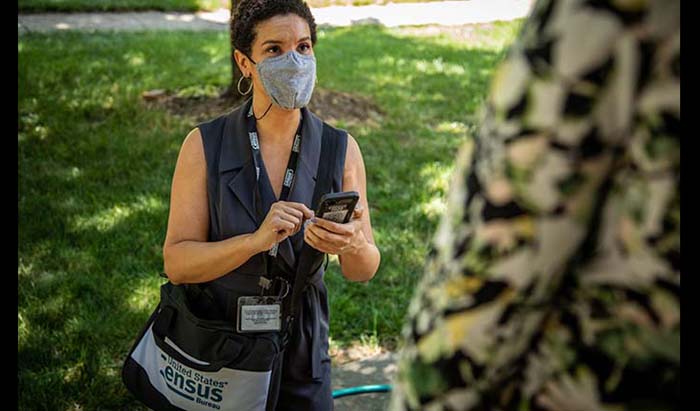
U.S. Census Takers in your Neighborhood. You may see census takers, known as enumerators, in your neighborhood to collect responses to the 2020 Census. Census takers will only be visiting homes that haven’t yet responded to the Census online, by phone or by mail. All census takers completed a virtual COVID-19 training on social distancing and other health and safety protocols and will follow CDC and local public health guidelines when they visit. All Census takers are required to wear a face mask and will also be equipped with hand sanitizer and gloves.
Census takers are hired from your area, and their goal is to help you and everyone in your home be counted in the 2020 Census. If the census taker who visits your home does not speak your language, you may request a return visit from a census taker who does speak your language. If no one is home when the census taker visits, the census taker will leave a notice of their visit with information about how to respond online, by phone or by mail.
Below are reminders to help you identify a Census taker:
- Census takers and field representatives will conduct their work between the hours of 9 am and 9 pm.
- All Census takers or field representatives will present an ID badge that includes their name, their photograph, a Department of Commerce watermark, and an expiration date.
- In addition to wearing a mask, all Census takers or field representatives will have an official 2020 Census bag and Census Bureau-issued electronic device, such as a laptop or smartphone, bearing the Census Bureau logo. There will be an “official business” notice on their car.
- Official Census takers will NEVER ask to enter your home. They will never ask for money, threaten detainment or deportation, or request additional documentation. They will only ask questions that are on the official Census questionnaire.
- You can find additional information about Census takers by clicking here.
- If you still have questions about a Census taker’s identity, you can call 844-330-2020 to speak with a local Census Bureau representative.
U.S. Census Emails. The Census Bureau also recently began emailing households that have not yet responded to the Census. Emails will be sent to all households in low-responding areas, even to those households that have responded. The email messages will come from 2020census@subscriptions.census.gov and will have a link to the Census self-response page. There will be an option to opt out of receiving future messages.
The Census Bureau is also considering sending text messages to areas that have low response. If such a decision is made, more information will be available prior to deploying the outreach.
Four Ways to Respond. There are four ways to respond to the 2020 Census: online, by phone, by mail or in person (with the help of Census taker who will be visiting households which have not yet responded). Visit https://my2020census.gov/ to complete the Census online or call 1-844-330-2020 to complete the Census by phone. Additional phone numbers for a variety of languages can be found at https://2020census.gov/en/contact-us.html. You can also mail in the form you should have received in March from the Census Bureau.
Questions Asked. The Census asks how many people are living in your household as of April 1, 2020. The Census asks just 10 basic questions: name; number of people living or staying in the home on April 1, 2020; whether the residence is owned or rented; telephone number (only to be used if needed for official Census Bureau business); sex; age; date of birth; Hispanic origin; race; and relationship with other household members.
When completing the Census, please note that college students should be counted where they would have been staying on April 1, 2020, even if they went home early due to a COVID-19 school closure or a shift to distance learning.
There is no citizenship question on the 2020 Census. The Census will never ask for citizenship or immigration status, social security numbers, money or donations, anything on behalf of a political party or for your bank or credit card account numbers.
Your Data is Protected. The U.S. Census Bureau is bound by law to protect your answers and keep them strictly confidential. In fact, every employee takes an oath to protect your personal information for life. Under Title 13 of the U.S. Code, the Census Bureau cannot release any identifiable information about you, your home, or your immigration status, even to law enforcement agencies. The law ensures that your private data is protected and that your answers cannot be used against you by any government agency or court. The answers you provide are used only to produce statistics.
Avoiding Scams Online: The use of any website that mentions being affiliated with the U.S. Census should be verified. The easiest way to verify the site is to check if address includes “.gov,” as only official U.S. and state government websites can use “.gov.” Fraudulent sites purporting to be official government service providers may steal personal information.
Reporting Suspected Fraud: If you suspect fraud, call 844-330-2020 to speak with a local Census Bureau representative. If it is determined that the visitor who came to your door does not work for the Census Bureau, contact your local police department.
Official Census information can be found by visiting the U.S. Census Bureau website and by visiting New York State’s Census website.
The New York State Department of State also offers the following resources to help New Yorkers:
Office for New Americans Hotline 1-800-566-7636: The Office for New Americans’ free hotline is available from Monday through Friday from 9AM to 8PM and can help new Americans in more than 200 hundred languages. For more information on the Office for New Americans, visit the website at https://www.newamericans.ny.gov/. The Office can also be reached via Twitter at @NYSNewAmericans or Facebook at https://www.facebook.com/NYSNewAmericans.
DCP Consumer Helpline 1-800-697-1220: The DCP Consumer Helpline offers safe, direct assistance for any New Yorker who believes they have been treated unfairly while in the marketplace. To report suspected Census fraud or scams, call the DCP Consumer Helpline at 800-697-1220, Monday through Friday, 8:30am-4:30pm or visit the DCP website at www.dos.ny.gov/consumerprotection. The Division can also be reached via Twitter at @NYSConsumer or Facebook at www.facebook.com/nysconsumer.
Consumer Alert: New York State Division of Consumer Protection Alerts Consumers to a Rise in Online Shopping Complaints During Covid-19 Pandemic
Online Shopping Complaints are Increasing as more Consumers Rely on Online Purchases During COVID-19
Simple Tips can Help Protect New Yorkers when Shopping Online
The New York State Division of Consumer Protection (DCP) is alerting consumers to a rise in online shopping complaints as the COVID-19 pandemic continues. According to Federal Trade Commission (FTC) data, online shopping complaint trends continue their upward trajectory. The FTC reports that during April and May 2020, more people reported issues with online shopping than any other months on record, with more than half never receiving the products they ordered.[1] Of the 84,000 Online Shopping and Negative Review complaints reported to the FTC in the second quarter of 2020, New Yorkers reported over 4,400 complaints and 75% resulted in monetary loss. [2],[3]
“As New York State continues it data-driven, phased in approach to reopening, many of us continue to stay at home as much as possible. Finding the items we need such as masks, gloves, or hand sanitizers may be difficult at our local stores, making online shopping more appealing,” said Secretary of State Rossana Rosado, who oversees the New York State Division of Consumer Protection. “Online shopping offers convenience and keeps us safe at home during these trying times, but we must be careful to whom we give our hard-earned money, especially online.”
Below are tips for New Yorkers to help keep protect your online purchases:
Know Your Rights:
- The Federal Mail, Internet, or Telephone Order Merchandise Rule (the Mail Order Rule) of 1975, updated in 2014[4] to include online orders, applies to merchandise sold to consumers online, by mail or by phone. It states that your order must be delivered within 30 days unless otherwise stated. If there is a delay, you must be notified. If the company cannot reach you to obtain your consent to the delay, they must, without being asked, promptly refund all the money you paid for the unshipped merchandise.
Savvy Online Shopping Tips:
- Shop on trusted sites with retailers known to you. In the era of social media marketing and influencers, consumers are more exposed to sham businesses that advertise a premier product but only deliver a low quality version of the advertised item, if they deliver anything at all. Use caution on trusted sites that host items for third party sellers.
- Beware of third party vendors If redirected from a trusted site to a third party site, read the sellers policies, review ratings, read consumer comments and most importantly do a broad internet search before making your purchase. Trusted retailers who host third party sellers do not warranty their sales, thus you could get a substandard product or no product at all when you take the risk and purchase from an unknown third party vendor.
- Do your research if you want to try a new site or retailer. Performing a broad internet search will provide you with important feedback from other customers. Are there any reviews? How is the company responding to its customers? Read the comments within any social media advertisements. This will help you assess what to expect if something goes wrong.
- Read the product specifications. Online marketing is geared to get you to buy so it is important to understand the product you are purchasing and the terms of the sale to ensure you are getting what you want.
- Comparison shop. Search other websites to compare price, quality, return policies, delivery cost and speed. Buying the “cheapest” advertised price may cost you more when you factor in delivery charges in the short term or return policies in the long term.
- Protect your privacy. Our devices are generally defaulted to share the maximum amount of data as possible. Take precautions and make changes to your settings to limit the personal data you share.
- File a complaint. If you are not satisfied with your online shopping experience, you should file a complaint online anytime at www.dos.ny.gov/consumerprotection, or call the Consumer Helpline at 800-697-1220, Monday through Friday, 8:30am-4:30pm to request a complaint form.
Tips for Using Credit Cards Online:
- Check the website’s encryption, it’s easier than you think. Before entering your credit card information, make sure that the website’s address begins with “https” and that there is a closed lock or unbroken key symbol in the lower portion of your window or up on the website address bar.
- Don’t keep the credit card on file for future purchases. Provide your credit card number each time you make a purchase.
- Designate one credit card and one email address for online shopping. This will allow for easy review of purchases and provide protection in case of a dispute.
Online Privacy Protection Tips:
- Protect your passwords. The key to safe passwords is to update them regularly and make them unique. Try using a passphrase instead of a password and include special characters and numbers. If it’s difficult to remember so many passwords, try a password manager with two-step authentication to manage your passwords.
- Avoid autofill. Saving usernames, passwords, and credit card information on your device saves time. Unfortunately, it also makes it easier for thieves to get access to that information if they access your account or device. Re-entering important information each time – as opposed to autofill – is an extra step to safeguard personal information.
- Check social media logins. Many apps allow you to use your social media credential to create a new account on their platform, but when you stop using those apps, your social media accounts still have access to the information. Once a year, check the list of apps that you access through your social media account and delete any you do not recognize or no longer use.
- Secure your connections. Do your shopping while connected to a secure network, rather than public WiFi or an unknown WiFi server. Public WiFi does not mask any information, even if a website or app seems secure. Usernames, passwords, credit card and account information can be easily seen by hackers who are logged into the same network. On home networks, keep operating systems and antivirus software up to date with the latest security patches and ensure the network has a strong password.
- Don’t become the product. Everything you do on your computer or device creates a digital imprint. That information is often compiled, tracked and sold to interested parties to better market products directly to you. This is called “behavioral advertising”. You can shut this feature off on your devices. Go to your device’s main settings and look for the settings marked “Privacy.” You can adjust the privacy settings to your comfort level.
The New York State Division of Consumer Protection serves to educate, assist and empower the State’s consumers. For more consumer protection information, call the Consumer Helpline at 800-697-1220, Monday through Friday, 8:30am-4:30pm. Consumer complaints can be filed anytime online at the Division website, www.dos.ny.gov/consumerprotection. Follow the Division at @NYSConsumer or www.facebook.com/nysconsumer.