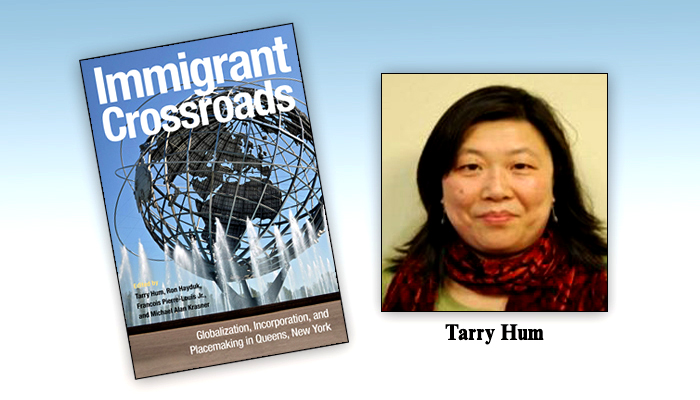
Tarry Hum and her co-editors have crafted an important go-to-book Immigrant Crossroads: Globalization, Incorporation, and Placemaking in Queens, New York. As I read this informative text, it invoked the ancient Greek notion of becoming. In contemporary terms, Queens County is a transformational borough that is in the process of becoming.
 This wide-ranging collection provides a detailed interdisciplinary overview of the bottom-up immigrant processes that are rapidly transforming Queens County and New York’s future as an innovative and thriving city of immigrants. Academics, journalists, and insurgent immigrant activists will be well served by the overlapping qualitative and quantitative essays that critique the reigning Olympian certitude that, until recently, informed elite decision-makers in global New York.
The book includes fourteen chapters organized around three inter-disciplinary sections: globalization; incorporation; and placemaking. And due to the existing complexity of contemporary immigration – in a borough and citywide landscape marked by pre-existing institutional rigidities – the social dynamics of reaction and resistance tend to overlap. Nonetheless, the text captures a thematic unity. The essays detail bottom-up initiatives in securing more expansive and inclusive forms of immigrant social, political, civic, and economic engagement — thus providing the analysis with a unifying thread.
The tome’s first section addresses how globalization, via massive waves of immigration from the global south in conjunction with ethnic spatial succession, transformed the borough’s second- and third- generation immigrant European neighborhoods into dynamic non-white migrant economic hubs. These demographic changes are accompanied by neoliberal deindustrialization, exploding rates in the establishment of family-owned immigrant businesses, and dramatic changes in land use and service-based employment patterns.
The second section revolves around immigrant struggles of migrant incorporation and the modification of encrusted and exclusionary political/civic arenas. The essays address such varied topics as: the rise of proactive immigrant advocacy groups and politically savvy South Asian nonprofits; language access in NYC pharmacies, as a mechanism for streamlining the delivery of neighborhood-based immigrant health needs; emergence of insurgent first- and second-generation immigrant politicians and the restructuring of the Queens Democratic political machine; incremental implementation of community-based participatory budget mechanisms. In sum, these developments represent innovative forms of immigrant initiatives that are recalibrating the borough’s political landscape along more inclusive lines. In brief, the proverbial genie is out of the bottle and a more proactive and grounded immigrant political geometry is clearly erupting.
The third section addresses the character of immigrant placemaking. As the old adage states, all politics are local. Yet, the various authors highlight how under neoliberal capitalism, the politics of immigrant placemaking are largely informed by global/local concerns. The militant particularism of American Muslims and Haitians immigrants, which face the onslaught of ongoing structural ethno-racial bias, are deftly documented as they creatively build counter institutions and socio-political practices that transnationally link their local places of residence with their respective cultures and traditional homelands.
The essay by Samuel Stein and Tarry Hum on Roosevelt Avenue is a pivotal chapter that brings to the fore the innovative immigrant assemblages that emerged in reaction to the neoliberal proposal to expand a business improvement district along this important immigrant crossroad. The narrative illustrates the complex dynamics associated with immigrant community building and the successful role played by the local immigrant press and countervailing neighborhood-based social movements in resisting corporate incursion into migrant Jackson Heights. On the flipside, Donavan Flinn an academic and local community activist, details immigrant placemaking – in and around Flushing Meadows Park– as a series of wins for corporate capital and setbacks for insurgent immigrant resisters. In this regard, Flinn’s chapter provides the reader with somber assessment of the ongoing challenges facing immigrant activists as they confront neoliberal megaprojects of misdevelopment.
Queens County is a liquid fluid borough that is experiencing the ongoing demise of legacy structures and institutions. As such, because of the constraints of time and space, the analytics represents a fleeting snap shot of ongoing change. In this regard, I have no doubt that this important text, at some point, will be revised and updated. That being the case, we should look forward to a rich discussion on the Covid-19 pandemic’s devasting impact on immigrant landscapes, the emerging progressive role of women in electoral politics, and the social movements that successfully confronted Amazon’s corporate incursion into northwestern Queens. Nonetheless, as things stand, this volume is a formidable accomplishment and represents an important contribution to our understanding of the immigrant quest for social justice.
Arturo-Ignacio Sánchez, Ph.D. is an urban planner and the former chairperson of the “Newest New Yorker Committee” of Community Board 3, Queens. He has taught at Barnard College, City University of New York, Columbia University, Cornell University, New York University, Pratt Institute, and various Latin American universities.