The Coronavirus pandemic has punctured a core theme in New York’s mainstream immigrant narrative: The notion that migrants are, more often than not, successfully incorporated into the city’s social and economic fabric. The Covid-19 plague brutally deflated New York’s mythical storyline – of immigrant urban exceptionalism – by unmasking long-standing divides that structurally marginalized the iconic immigrant communities of Corona, Elmhurst, and Jackson Heights. While divisive fractures characterize many aspects of immigrant neighborhood life, they are particularly evident, in the weak linkages between cutting-edge information technology (I.T.) and migrant usage.
Before entering into the discussion on I.T. and immigrants, it would be useful to briefly highlight the pandemic’s devastating impact on the health and well-being of migrant that reside in the communities of northwestern Queens.
As a city of immigrants, New York was the initial U.S. epicenter for the Covid-19 pandemic. According to citywide data (compiled in May), organized by zip codes, Queens County is the most infected borough. The northwestern immigrant-packed neighborhoods of Corona (11368) comes in at number 1, with 3,990 confirmed cases; Elmhurst (11373) is number 3, with 2,927 confirmed cases; and Jackson Heights (11372) is ranked 8, with 2,276 confirmed cases. This tsunami of disease, death, and desperation ripped through northwestern immigrant Queens with devastating consequences.
New York is an information intensive global city. Before the pandemic, essential resources for households and individual were increasingly accessed through computers. And as the Covid-19 crisis ripped through the city, delivery of medical consultations, education, emergency social services, and other essential forms of information increasingly migrated online. Consequently, computer access emerged – in a plague dominated environment – as a basic resource for immigrant survival.
Covid-19 highlights the dramatic divide between the internet have and have nots. New York City’s internet inequality is a toxic fact of life that endangers immigrants. This is especially so for undocumented impoverished immigrants, that lack adequate access to crucially needed information. Case in point: The New York City Comptroller’s Office documented that 32% of Latinx city residents lacked broadband internet access, while 80% of the white population reported having broadband connectivity. And, at a more generalized national geographic scale, a Pew Research Center survey found that 65% of Latinx respondents stated that access to the internet was viewed as essential during the coronavirus outbreak. Yet, disconcertingly, 54% of U.S.-based Latinos reported deep concern about paying their home broadband and cell phone bills, compared with 36% of African American and 21% of white users.
Historically, the deleterious shocks of natural disasters and economic dislocations are never equally distributed. The Covid-19 plague is a transformative event that accelerated, reinforced, and deepened pre-existing ethnic, racial, class, geographical, and technological divides. The unequal geographical distribution of public and private resources, reinforced by long-standing institutional racism, ultimately framed immigrant vulnerability and responses to the pandemic’s ravishing effects.

According to Covid-19 data compiled by The New School’s Center for New York City Affairs, Queens Latinx immigrant labor markets have been unduly decimated. 57% of Queen’s workers were classified as workers in low paying face-to-face industries. And it’s precisely these types of precarious immigrant service jobs which hemorrhaged massive losses. The loss of employment among: hotel workers; housekeepers; home healthcare workers; restaurant/bar personnel; and informal and formal street vendors,
The geography of infection and generalized distress in the neighborhoods of Corona, Elmhurst, and Jackson Heights is immediately palpable. The major transportation corridors of Roosevelt Avenue, Junction Boulevard, Northern Boulevard, and 37th Avenue, which function as important immigrant retail/employment sites, are locked-down and depopulated. Nonetheless, there are still pockets of scattered street-level activity. Pre-existing impoverishment and the secondary unemployment impacts – triggered by the plague – resulted in long lines at neighborhood foodbanks and at Elmhurst Hospital, where immigrants lacking health insurance, anxiously flocked to the under-financed and overburdened municipal health provider.
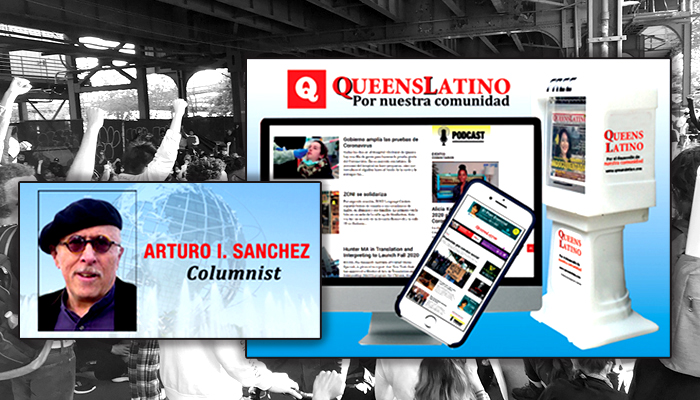
Clearly, Latinx immigrants are wallowing in a data/information desert. This does not bode well, during these times of desperate need, when migrants require access to pertinent and timely information. In Queens, economic and information deprived immigrants have come to increasingly rely on free Spanish language community newspapers for crucial information. In a so-called post-print computer dominated information environment, where hardcopy newspapers are an endangered means of communication, this is clearly a curious, ironic, and practical outcome. In this context, QueensLatino, the hybrid print/digital community newspaper, specializes in local Latinx advocacy journalism, neighborhood reporting, and opinion – emerged as an important source of information for Spanish dominant immigrants and a wide-range of Queens-based social justice activists.
In a data/information depleted environment, if information is a form of power, then community-based newspapers such as QueensLatino are a much-needed tool for immigrant engagement, advocacy, and survival.
Arturo-Ignacio Sánchez, Ph.D. is an urban planner and the former chairperson of the “Newest New Yorker Committee” of Community Board 3, Queens. He has taught at Barnard College, City University of New York, Columbia University, Cornell University, New York University, Pratt Institute, and various Latin American universities.
(This is an abridged version in Spanish of Arturo I. Sánchez’s column)
Coronavirus: inmigrantes & acceso a la información
La pandemia del Coronavirus ha tocado un tema importante de la narrativa del inmigrante en Nueva York. La noción de que los inmigrantes de alguna forma se han incorporado con éxito al tejido económico y social de la ciudad. La plaga del Covid-19 ha desenmascarado la marginalización de las comunidades inmigrantes de Corona, Elmhurst y Jackson Heights. Algo muy evidente es la débil conexión entre la tecnología más avanzada y los inmigrantes.
Antes de entrar en la discusión de la tecnología y los inmigrantes, es importante referirnos al impacto negativo de esta pandemia en este vecindario. Nueva York, ciudad de inmigrantes, fue el epicentro del Covid-19. De acuerdo a cifras oficiales del mes de mayo, este fue el condado más afectado. Corona es número 1 con 3,990 casos, Elmhurst número 3 con 2,927 casos y Jackson Heights número 8 con 2,276 casos. Un impacto devastador.
Nueva York es también una ciudad global de la información. Con la pandemia muchos de los servicios, como educativos y médicos, se desplazaron al Internet. El uso del computador se volvió vital en la sobrevivencia del inmigrante. Una inequidad tóxica en especial para los indocumentados. La oficina del contralor de NYC documentó que el 32% de latinos no tienen acceso a Internet de banda ancha y el Pew Research Center halló que el 54% tienen problemas para pagar por el servicio de celular (36% para afroamericanos y 21% para blancos). El Covid-19 simplemente profundizó la división étnica, racial y tecnológica.
Para el Center for NYC Affairs del New School, la fuerza laboral de los latinos en Queens se ha diezmado. El 57% de los trabajadores de Queens son de la industria de atención al público y ganan poco, como empleados de hoteles, amas de casa, personal de restaurantes y bares y vendedores ambulantes. Precisamente los más afectados. Este impacto es palpable en Corona, Elmhurst y Jackson Heights. Se aprecia en las calles y en el Hospital Elmhurst que atiende a quienes no tienen seguro médico.
Una comunidad inmigrante que ahora más que nunca depende de los periódicos como fuente de información en español. Algo curioso en esta industria en donde QueensLatino se especializa en información local a nivel digital e impresa. Emerge como una fuente vital de información y opinión para los inmigrantes latinos. Es una herramienta para que la comunidad participe, un vehículo para defender a los latinos y un armar de sobrevivencia.