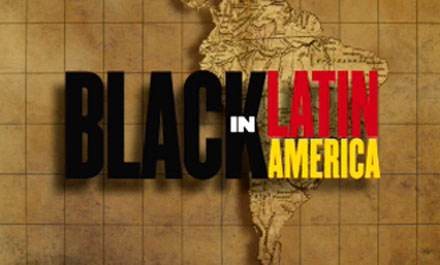
Black in Latin America is the 11th documentary from Professor Gates whose previous PBS projects include African American Lives 1 and 2, Oprah’s Roots, Looking fo Lincoln, and Faces of America, among others Six Latin American countries are featured in the series: Brazil, Cuba, the Dominican. Republic, Haiti, Mexico and Peru. It premiers Tuesday, April 19 on PBS, channel 13.
The series is the third part of a trilogy which began 12 years ago with Wonders
of the African World.
Black in Latin America, a new four-part series on the influence of African descent
on Latin America, is the 11th and latest documentary film from renowned Harvard
scholar Henry Louis Gates, Jr. presenter and writer of the acclaimed PBS series
African American Lives (2006), Oprah’s Roots (2007), African American Lives 2(2008), Looking for Lincoln (2009) and Faces of America (2010).
Black in Latin America is the third of a trilogy that began in 1999 with the broadcast
of Professor Gates’ first series for public television, Wonders of the African World,
an exploration of the relationship between Africa and the New World, a story he
continued in 2004 with America Beyond the Color Line, a report on the lives of modern-day African Americans. Black In Latin America, premiering nationally Tuesdays April 19, 26 and May 3, 10, 2011 at 8 p.m. (ET) on PBS (check local listings), examines how Africa and Europe came together to create the rich cultures of Latin America and the Caribbean.
Latin America is often associated with music, monuments and sun, but each of the
six countries featured in Black in Latin America including Brazil, Cuba, the Dominican Republic, Haiti, Mexico and Peru, has a secret history. On his journey, Professor Gates discovers, behind a shared legacy of colonialism and slavery, vivid stories and people marked by African roots.
12.5 million Africans were shipped to the New World during the Middle Passage. While just over 11.0 million survived the arduous journey, only about 450,000 of them arrived in the United States. The rest-over ten and a half million-were taken to
the Caribbean and Latin America and kept in bondage far longer than the slaves
in the United States. This astonishing fact changes the entire picture of the history
of slavery in the Western hemisphere, and of its lasting cultural impact. These
millions of Africans created new and vibrant cultures, magnificently compelling
syntheses of various African, English, French, Portuguese and Spanish influences.
Despite their great numbers, the cultural and social worlds that they created remain
largely unknown to most Americans, except for certain popular, cross-over musical
forms. In his new series, Professor Gates sets out on a quest to discover how Latin
Americans of African descent live now, and how the countries acknowledge-or deny-their
African past; how the fact of race and African ancestry play themselves out in the
multicultural worlds of the Caribbean and Latin America. Starting with the slave
experience and extending to the present, Professor Gates unveils the history of
the African presence in six Latin American countries through art, music, cuisine,
dance, politics and religion, but also the very palpable presence of anti-black
racism that has sometimes sought to keep the black cultural presence from view.
Episode One
Haiti & the Dominican Republic: An Island Divided
In Haiti, Professor Gates tells the story of the birth of the first-ever black republic,
and finds out how the slaves’ hard fought liberation over Napoleon Bonaparte’s French Empire became a double-edged sword. In the Dominican Republic, Professor Gates explores how race has been socially constructed in a society whose people reflect centurias of inter-marriage, and how the country’s troubled history with Haiti informs notions about racial classification.
Episode Two
Cuba: The Next Revolution
In Cuba, Professor Gates finds out how the culture, religion, politics and music
of this Island are inextricably linked to the huge amount of slave labor imported
to produce its enormously profitable 19th century sugar industry, and how race and
racism have fared since Fidel Castro’s Communist revolution in 1959.
Episode Three
Brazil: A Racial Paradise?
In Brazil, Professor Gates delves behind the façade of Carnival to discover how
this ‘rainbow nation’ is waking up to its legacy as the world’s largest slave economy.
Episode Four
Mexico & Peru: The Black Grandma in the Closet
In Mexico and Peru, Professor Gates explores the almost unknown history of the significant
numbers of black people-the two countries together received far more slaves than
did the United States -brought to these countries as early as the 16th and 17th
centuries, and the worlds of culture that their descendants have created in Vera
Cruz on the Gulf of Mexico, the Costa Chica region on the Pacific, and in and around
Lima, Peru.
In Black in Latin America, Professor Gates’ journey becomes ours as viewers are
introduced to the faces and voices of the descendants of the Africans who created
these worlds. He shows the similarities and distinctions between these cultures,
and how the New World manifestations are rooted in, but distinct from, their African
antecedents. A quest he began 12- years ago with Wonders of the African World comes
full-circle in Black in Latin America, an effort to discover how Africa and Europe
combined to create the vibrant cultures of Latin America, with a rich legacy of
thoughtful, articulate subjects whose stories are astonishingly moving and irresistibly
compelling.
The companion website for Black in Latin America, launching March 22, will feature
video of the entire series, interactive timelines for each of the countries focused
on in the films, as well as commentary from the series’ executive producer, writer
and presenter Henry Louis Gates, Jr. The website (http://www.pbs.org/black-in-latin-america/
[http://r20.rs6.net/tn.jsp?llr=hlnfsnbab&et=1105038070412&s=18766&e=001a1tKQt_xCDFIukviSZxLyooIRYjHbOwlYP0kpwtmZbzEg8LJhKMOyJ7oeuYQV5p4z-G9XrS90MJxbMhvOdkUn_FDCNo8EeiP4Lrzd1eyoyQ9o15HTHrAjS6-Bs46byNnay7yG6myEno=])
will offer resources that viewers can use to learn more about the history of race
in the featured countries, essays by academics who contributed to the series and
an extensive glossary of people, places and terms referenced in the films.
A Spanish SAP track for Black in Latin America will be available on the broadcast
version and on the home video available on Blu-ray and DVD through PBS Home Video
beginning June 2011 at ShopPBS.org, 800-531-4727.
The companion book, Black in Latin America, written by Professor Gates, will be
published in 2011 by NYU Press.
Black in Latin America is a production of Inkwell Films, Wall to Wall Media Limited
and THIRTEEN in association with WNET. Written and presented by Henry Louis Gates, Jr. Executive producers are Henry Louis Gates, Jr., Jonathan Hewes and William R.
Grant. Series producer is Ricardo Pollack. Directors are Ricardo Pollack (Haiti
& the Dominican Republic: An Island Divided and Brazil: A Racial Paradise?), Diene
Petterle (Cuba: The Next Revolution) and Ilana Trachtman (Mexico & Peru: The Black
Grandma in the Closet).
Funding for Black in Latin America is provided by the Corporation for Public Broadcasting, Public Television Stations and Viewers Like You. Additional funding is provided by the Ford Foundation, Richard Gilder and Alphonse Fletcher.