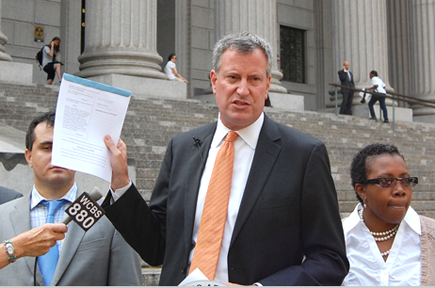
Public Advocate Bill de Blasio released an analysis of increasing inspections and fines that disproportionately hit small businesses in the outer boroughs, including immigrant entrepreneurs in Queens.
“This is incredible, an attract to small businesses and the Latino immigrant community in general,” said Eduardo Giraldo, owner of Abetex, an insurance company in Jackson Heights, Queens and former president of the Hispanic Chamber of Commerce of Queens. “We need to organize and fight back.”
Frank García, president of the Coalition of New York State Hispanic Chamber of Commerce added: “The problem with the Latino community is that we allow this kind of abuse. We need to get together and fight back, we are here to help.” García went to downtown Manhattan to witness the release of the report by de Blasio who is also a candidate for Mayor of New York City.
The report, Borough Bias: How the Bloomberg Administration Drains Outer Borough Businesses, takes a comprehensive look at fine-related data de Blasio secured through a lawsuit against City agencies. It proves what many business owners have witnessed for years: an unannounced enforcement campaign begun in 2010 has led to a dramatic increase in inspections and nuisance fines on small businesses. This spike in inspections, fines and violations coincides with failing City revenues as a result of the Great Recession.
“While the data is not at all surprising given the amount of complaints we receive from our local small businesses, it is very distressing to learn that city agencies are disproportionately issuing tickets and fines to small business owners in lower-income neighborhoods of the city, such as Corona, where many families are striving to make ends meet,” said Council Member Julissa Ferreras. “Every city agency has an obligation to provide assistance to all small business owners and all New Yorkers, not just those who located in downtown Manhattan. That is exactly why I allocate funding to local organizations that provide information to local businesses on their rights and responsibility.”
According to the report, that burden has fallen hardest on the outer boroughs. The report shows businesses in the Bronx, Brooklyn, Queens and Staten Island receive more frequent inspections than Manhattan—especially neighborhoods south of 96th Street—by agencies like the Department of Consumer Affairs, and are consequently issued more fines.
“The farther you get from City Hall, the more likely your business is to get inspected and fined. That’s no way to balance a budget and it’s no way to spur hiring in the boroughs that need it most,” said Public Advocate Bill de Blasio. “These fines are a $50 million hidden tax that was levied on small businesses without warning or debate. The Mayor can’t keep burdening outer borough neighborhoods with frivolous fines to balance the City’s books.”
The report’s review of Department of Health and Mental Hygiene and Department of Consumer Affairs records found not only a sharp increase in inspections made, violations issued and fines levied, but also deep borough inequities in the frequency of inspections and the likelihood of receiving fines.
Read the full report: http://advocate.nyc.
Among the key findings:
1) Inspections made, violations issued and fines levied between Fiscal Years 2010 and 2012 by DCA and DOHMH are all up dramatically.
- FY10-FY12, DCA increased inspections by 66 percent, increased violations issued by 153 percent, and increased revenue from fines by 102 percent.
- FY10-FY-12, DOHMH increased inspections by 55 percent to 98,176 visits, increased violations issued by 73 percent, and increased revenue from fines by 90 percent.
2) In gross numbers, both agencies have increased annual fine revenue during this period by a combined $50 million.
- Even as the number of violations issued spiked, the dollar amount of individual fines plummeted 30 percent, reflecting inspectors issuing a profusion of penalties for low-level violations.
3) Outer borough businesses are inspected more often and pay more in fines.
- Compared to the citywide average, businesses in the Bronx are inspected by Consumer Affairs 8 percent more frequently, those in Brooklyn are inspected 4 percent more, as are those in Queens (2 percent) and Staten Island (1 percent). Businesses in Manhattan receive 14 percent fewer inspections than the citywide average.
- The most frequently inspected neighborhoods by Consumer Affairs were Morrisania (inspected 3.1x more often than the average neighborhood), Central and North Harlem (2.8x and 2.5x more often, respectively) and Highbridge (2.5x).
- Because of more frequent inspections, Bronx businesses pay 7 percent more Consumer Affairs fines on average, those in Brooklyn pay 5 percent more, as do those in Queens (4 percent) and Staten Island (2 percent). Businesses in Manhattan pay 18 percent less in fines per business than the citywide average.
- The most heavily fined neighborhoods by Consumer Affairs in FY2012 were Laurelton (fined at 5.8x the citywide average), Rosedale (4.4x), Woodlawn (3.8x), Red Hook (3.4x) and Edenwald (3.4x).
- Of the 10 neighborhoods with the highest rate of health violations per restaurant, 6 were in Queens and 4 were in Brooklyn.
“I applaud Public Advocate Bill de Blasio for conducting this important study and for challenging this administration regarding why businesses in minority communities are being given steeper fines as compared with businesses in other more wealthy parts of the city,” said Assembly Member Gabriela Rosa. “Most alarming to me is how this is impacting my home community of Washington Heights and begs to question whether these fines are being used to compensate for budget shortfalls on the backs of hardworking minority business owners who face enough struggles without having to be treated unfairly. I will do everything within my power to fight for the rights of businesses within my community and to ensure they are afforded the same opportunities to succeed as businesses in affluent neighborhoods.”
“Time after time this administration balances the city budget on the backs of the working and middle classes, leading to seemingly unbreakable cycles of poverty,” said Council Member Ydanis Rodriguez. “People in my community and others like it are left in shock by the findings in this report, put together by Public Advocate Bill De Blasio, and are left wondering why the American dream is suitable for some in our city but not others.”