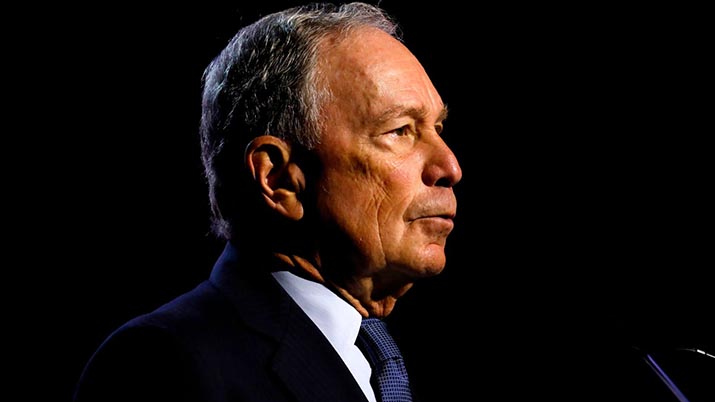
Nationally, rank-and-file Democrats are fixated on one overarching political goal — defeating Donald Trump. Their driving assumption is that the sitting president personifies a clear and present danger to the nation’s institutions and the common good. With the hope of achieving this objective, party activists and media pundits are looking at Michael Bloomberg as a proverbial white knight who has the economic resources, and political trajectory to go head-to-head with Donald Trump in a contentious bare-knuckle election.
The growing ground swell lifting the former New York City mayor, as a feasible Democratic candidate, needs to be critically evaluated with regards to the current political landscape and his tenure as the Big Apple’s technocratic burgomaster.
The contemporary political moment is characterized by a systemic legitimation crisis and a deep disenchantment with an elite dominated status quo that favors the few over the many. Climate change, growing levels of income inequality, downward economic prospects, racial and ethnic socio-economic disparities, and explosive levels of homelessness have mobilized large swaths of the population in calling for new socially just political arrangements. In short, the finance-driven global plutocrats and national billionaires who gerrymandered the current landscape are now being seriously questioned. Hence, the growing allure – especially among youth – for Bernie Sanders and his system altering political platform.
In this novel context, Bloomberg’s prospects bring to the fore the long-standing warning of caveat emptor (buyer beware). As a mega-billionaire – with tons of money to spend on buying the nomination – is at odds with an emerging bottom-up mindset that emphasizes social justice and bottom-up political engagement that will rein in unregulated corporate power.
Bloomberg’s supposed political sheen is tarnished by his transactional political maneuvers which are slickly packaged as a form of astute political pragmatism. In his quest to secure the Democratic Party’s nomination, Bloomberg’s Machiavellian transactionalism is writ large when one considers his: opportunistic switch from the Republican to the Democratic Party; purchasing political allegiances and silencing possible criticism via his philanthropic largess; financially coopting youthful mercantile internet “influencers” with the craven intent of appealing to young voters by crafting a hip and progressive narrative.
The branding of Bloomberg as a shiny new commodity flies in the face of the prevailing countervailing political mood. Nonetheless, the Bloomberg brand is closely aligned with the mindset that marked his three-term New York mayoral administration. As mayor, Bloomberg cultivated a packaged script that marketed his persona as a self-made businessman and a technocratically efficient and pragmatic administrator who, unlike ordinary venal officials, was beyond reproach because of his enormous wealth. This mode of capitalist exceptionalism supposedly positioned him above the fray and facilitated the crafting of a corporate version of common good that revolved around neoliberal economic growth in the financial sector, real estate, high tech, and tourism. This elite-informed policy perspective framed his marketing of the Big Apple as a spatially restructured global Luxury City designed to attract and service the so-called “best and brightest” and the rich and powerful.
Bloomberg’s policy of urban restructuring was facilitated by massive city-wide rezoning initiatives and an explosion of high-end mega construction projects that fast-tracked gentrification, middle- and working-class neighborhood expulsions, homelessness, and the accompanying devastation of small- and mid-scale businesses. Exploding levels of unemployment and social decomposition were aggressively addressed by a “stop and frisk” policing strategy that overwhelmingly targeted Black and Latino youth. In short, Bloomberg’s Luxury City corporate growth model clearly belies the notion that a rising tide lifts all ships.
Bloomberg’s Luxury City approach was a neoliberal class project that engendered a highly fragmented global metropolis that obliterates any notion of urban social justice. In short, Bloomberg’s history as New York’s CEO mayor does not bode well as a template for addressing the massive malaise that is wreaking havoc throughout the United States. In this moment of crisis, the businessperson as savior does not cut the mustard. What is needed is a reimagining of politics and a mass mobilization that will defeat Donald Trump and meet the overarching crisis(es) that mark this dire historical juncture. This cannot be accomplished by succumbing to the nonsensical notion that it takes a plutocrat to defeat another plutocrat. This short-sighted elitist notion does not hold water. Which closes the circle and brings us back to the initial proposition of caveat emptor – BUYER BEWARE!
Arturo-Ignacio Sánchez, Ph.D. is an urban planner and the former chairperson of the “Newest New Yorker Committee” of Community Board 3, Queens. He has taught at Barnard College, City University of New York, Columbia University, Cornell University, New York University, Pratt Institute, and various Latin American universities