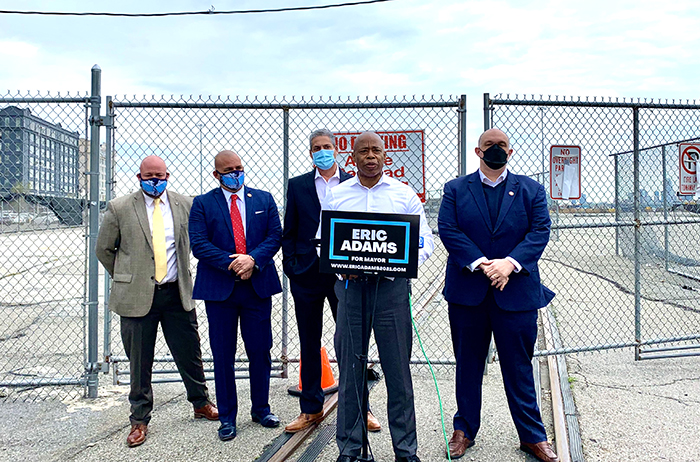
New York City mayoral candidate Eric Adams released his plan today to turn New York City into the wind power hub of the Northeast, calling the emerging industry “a tailwind for our new economy”.
Adams’ plan includes leveraging waterfront assets like the South Brooklyn Marine Terminal, the Red Hook Container Terminal, the Staten Island waterfront, the Brooklyn Navy Yard, and others to take advantage of new federal funding announced last week so that New York can design, construct and ship the components necessary to build wind farms in the region. And Adams specifically called for approval of the proposed Arthur Kill wind power facility in Staten Island.
You can read Adams’ full wind power plan here and attached. Photos attached.
“New York City has always been a hub for innovation, new ideas, and progressive thinking. There is no reason New York City shouldn’t be a leader in wind power. We have the resources and we can foster the talent–we just have not had the leadership to get it done,” said Brooklyn Borough President Eric Adams. “With forwarding thinking and smart planning, the wind power industry can be a tailwind for our new economy as we emerge stronger from COVID-19. And, most importantly, since we are building this new industry from scratch in New York, we can ensure that the good union jobs and prosperity that come from it go to the lower-income communities and communities of color that are struggling the most.”
“Thank you, President Biden, and thank you, Eric Adams,” said Frank Agosta, President Local 1814 International Longshoremen’s Association (ILA). “The investment in Brooklyn and Staten Island Port infrastructure is both an opportunity and essential. Our economy has to grow green and wind power is a key component. The men and women of the ILA are ready to work with all levels of government –City, State and federal — to make these investments a success.”
“The International Longshoremen’s Association is excited for the opportunity to bring jobs and clean energy to the shores of Staten Island with port infrastructure improvements to efficiently handle the shipment and assembly of tall, heavy wind turbines,” said Michael Izzo, President of ILA Local 920. “Staten Island can be a leader in clean energy that can also be an economic boom for New York City. Wind energy reduces pollution and generates good jobs – longshore jobs, manufacturing jobs and so much more.”
Adams would also commit to upfront capital investments to prepare our ports and harbors for the new industry. New York, New Jersey, Virginia, Massachusetts, Connecticut, Rhode Island, and Maryland have committed to buying 30,000 megawatts of offshore electricity over the next 14 years. This would be enough electricity to power 20 million homes and create tens of thousands of new jobs.
Adams also detailed his plan to create a wind power industry jobs pipeline in New York City from City schools through our colleges and City-sponsored job-training programs to get New Yorkers connected to waiting jobs in local businesses. Adams would include Career and Technical Education (CTE) high schools and CUNY schools like Kingsborough CC in his plan in order to guarantee the industry hires locally as it grows.
In addition to the increase in new, good-paying, long-term green jobs, Adams’ wind power plan will also help New York and the region achieve its renewable energy goals and do its part to stop climate change.
In January, the first step of Adams’ plan — the wind turbine plant in the South Brooklyn Marine Terminal — was announced after years of advocacy by Borough President Adams. Adams today proposed adding an additional manufacturing site at Arthur Kill in Staten Island, as well as job sites in the Navy Yard and at the Red Hook Container Terminal. He also proposed creating a state-of-the-art wind power jobs training center in Sunset Park, Brooklyn, and acknowledged the work of UPROSE and other community leaders there for their years of work pushing plans for green jobs and a working port for local residents to work at.
HOW WE MAKE NEW YORK CITY THE WIND POWER HUB OF THE EASTERN SEABOARD
With waterfront assets like SBMT, the Red Hook Container Terminal, Port Richmond, the Brooklyn Navy Yard, and others, we have an opportunity to corner the market on wind power manufacturing and other related green technologies. We must also create a pipeline of education training from middle school, high school and college to educate our young people in this field and link New Yorkers with training and jobs. We can do all that with the following steps.
OLD PORTS, NEW TRICKS
New York City sits at the center of dozens of potential new wind power projects on the Eastern Seaboard, including those planned in Long Island, New Jersey, Virginia, Massachusetts, Connecticut, Rhode Island, and Maryland. All together, those areas have already committed to buying 30,000 megawatts of offshore electricity over the next 15 years–enough electricity to power 20 million homes.
These off-shore wind developers (OSWs) do not develop the port infrastructure to produce needed components and equipment for their wind farms themselves. They require manufacturing partners and port operators to complete and maintain their projects. That is where New York City and its famous ports can play a role–as they have for centuries as the facilitator of commerce and new industries.
My plan is to leverage existing waterfront assets like the South Brooklyn Marine Terminal (SBMT), the Staten Island waterfront, the Red Hook Container Terminal, and the Brooklyn Navy Yard to become the new backbone of the East Coast’s wind power industry, where the industry will design, construct and ship the components necessary for wind power projects. In particular, I would focus on quickly opening two major new industrial sites at SMBT and Arthur Kills.
SBMT is already slated to open a facility to help build a Long Island wind farm led by Equinor, and that partnership was announced in January after advocacy from myself and others. But at about 800 megawatts that project is just a tiny fraction of the 30,000 megawatts of new wind power planned for the East Coast over the next decade-and-a-half–9,000 megawatts of which is slated for New York State alone. At the same time, the Biden Administration just announced commitments of $12 billion per year in capital investment toward the industry.
So the city’s existing plans to support the industry are far less ambitious than what is needed to fully harness the economic potential from the coming offshore wind expansion on the East Coast. So we must do much more. Here’s how:
DEVELOP NEW WIND POWER MANUFACTURING CENTERS, QUICKLY
The South Brooklyn Marine Terminal will be transformed into a turbine manufacturing and maintenance site for the Equinor project and should continue to serve the region’s wind power needs for years afterward–but its capacity is not nearly enough to handle all of the potential projects coming online over the next few decades.
That is why we must also build the proposed Arthur Kill facility in Staten Island. The
site would have no vessel access restrictions and could potentially ship out wind farm infrastructure to more than half-a-dozens states, directly and indirectly creating thousands of good new jobs and hundreds-of-millions-of-dollars in new economic activity.
EXPEDITE APPROVALS
But to get SBMT and Arthur Kill up-and-running as soon as possible, the City and State must quickly complete a number of critical authorizations and funding commitments–all of which I would do immediately as mayor. If there are delays in permitting and other government approvals, New York could miss out on its wind power windfall.
I would also create a Wind Power Development Team out of City Hall, staffed by industry experts and staff from the Economic Development Corporation, City Planning, Department of Environmental Protection and other relevant agencies to expedite our work to attract the industry to New York. I would also task that team to work directly with the Army Corps of Engineers on necessary port improvements to allow for new vessel traffic, as well as with the State to ensure its related environmental SEQRA process moves smoothly.
MAKE UPFRONT INVESTMENTS TO ATTRACT THE INDUSTRY
We cannot spend these critical next few years stuck in a game of chicken-and-egg, waiting for industry partners to guarantee contracts before the City takes measures and makes the investments necessary to become the most desirable location for the wind power industry.
That is why I would immediately push for local, State and federal funding to upgrade our ports and set aside City capital dollars for on-shore infrastructure costs that can be approved and ready to be deployed whenever a wind power provider partners with us on a new project. We cannot just make those preparations now for SBMT in Sunset Park–we must also plan as if other sites in Red Hook and Staten Island will be the next to join the industry. By doing all that, we will position ourselves ahead of competing states and cities vying for the same business.
COMMIT TO PURCHASING WIND POWER
To support the wind power industry’s growth, the City should use its own power as one of the largest purchasers of electricity. And very little of the energy we use to power our city today comes from renewable sources. In order to spur the wind power industry and create new jobs while meeting our climate change goals, I will commit the City to purchasing a certain percentage of its electricity from wind sources regionally.
THE TRAINING TO SUCCEED
According to the National Renewable Energy Laboratory, the wind power industry has expressed frustration in trying to find workers who are interested in entering their field or who have the right experience for it. Sixty-eight percent of wind industry firm representatives surveyed had difficulty hiring across most occupations.
That is a tremendous opportunity for our local workers to fill the skills gap and grab good-paying jobs in promising careers. We must help prepare them with job training and connections to waiting jobs in the wind power industry. Here’s how:
RECRUIT THE UNEMPLOYED IN LOWER˜INCOME COMMUNITIES AND COMMUNITIES OF COLOR
Unemployment in New York City is at historically high levels–and it is communities of color and lower-income communities that are hurting the most, where the rate is double what it is citywide. That is why I have proposed an unprecedented effort to link unemployed New Yorkers in these neighborhoods with training and jobs, working in partnership with employers and nonprofits that teach skills in all types of industries.
As part of this effort, we will also create a specialized green jobs program with extra funding, partnering with employers, labor and technical experts to quickly identify and train workers in lower-income communities. I will also fund a recruiting effort as part of the program, including NYCHA and community organization outreach efforts and local advertising.
CREATE A WIND POWER TRAINING HUB IN SUNSET PARK
It is essential that the communities located near wind power industrial sites have access to the training they need to get a job in their backyard. Sunset Park is the most logical place to add a state-of-the-art training hub, where unemployment is high and 40 percent of adult residents do not have a college education. I would seek to site it as close to SBMT as possible.
FUND A ROBUST CERTIFICATION PROGRAM
The wind power industry doesn’t just require skills training–it also needs workers who are certified to perform specific roles. Some of these certifications can cost thousands of dollars, which is another barrier to lower-income New Yorkers who are seeking well-paying careers.
For instance, a wind turbine service technician is one of the fastest-growing job in the United States, but it requires a one-year certificate program. That program costs $5,000, but the job pays an average of $53,000 a year. That is why I will budget $5 million to train 1,000 workers in the wind power industry as part of our outreach training program to prepare the next generation of workers.
LINKING OUR SCHOOLS
It is critical that our young people be included in this wind power revolution. To make sure they are, I will link our high schools and CUNY to the industry and create green economy curriculums. Here’s how:
EXPAND OUR CTE SCHOOLS
Our Career and Technical Education (CTE) high schools ready young people for careers with technical training, life skills and career-specific education that helps prepare students for college and the working world. I would increase the number of courses available and create a wind power and green jobs curriculum with input from the wind power industry.
CREATE A CUNY JOBS PIPELINE
Our CUNY schools are the perfect place to find and develop the workers needed to design, build and maintain wind power infrastructure. I will fully fund programs to do that. And then those programs can place graduates directly into training programs or jobs in the industry that lead to careers for young New Yorkers. Kingsborough Community College is a particularly attractive site for this initiative because of its location on the waterfront.