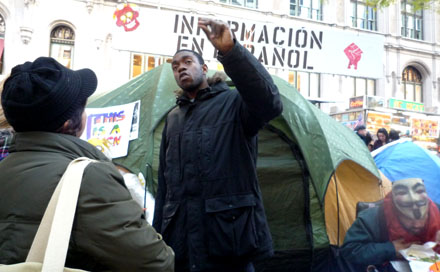
Commenting on the power of language, French writer Antoine de Saint Exupery said, “Language is the source of misunderstandings.” His words speak to the power that words have over people’s individual and collective understanding of the world around them and of the institutions and movements that could shape their future. If movements cannot speak the language of their constituents, then their meaning will be misunderstood, which is exactly what a subset of Occupy Wall Street’s protesters must have realized when they decided to set up a Spanish language version of ‘The Occupied Wall Street Journal.’
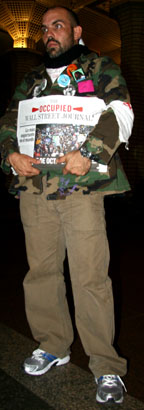
“We are Spanish-speaking so how can someone who wants to really get involved do that if all the material is in English?,” said Julio Rolon, one of the founders of the new paper.
Movement leaders tend to think that they highlight certain barriers while transcending others. They claim to represent a particular subset of a population and work to reach out to that group and generate interest in their cause. One of the most powerful barriers to successful outreach is language. When people are separated from a movement by language, they cannot be exposed to its tenets on any kind of deeper, emotional level, which in turn prevents the movement from engaging large numbers of potential supporters.
In Occupy Wall Street’s case protesters seek to unite Americans across socio-political and racial lines to bring attention to their belief that the country has developed deep class divisions between its wealthiest citizens and the rest of society. The movement, whose members are currently encamped in Manhattan’s Zuccotti Park, claims to represent “The 99%” of the United States. Many members of that 99% are Spanish-speaking Latino Americans but the movement’s English speaking publication, ‘The Occupy Wall Street Journal,’ is not accessible to those who are not bilingual. The result is the Spanish-version of the publication that currently is a translation but will begin featuring original content stories in its fifth issue later this month.
“This is important because people who are Spanish speakers experience the movement differently,” said Mike Griffiths, a college student involved with the publication. “There are some things that you cannot translate; the elements of language and depth that will help us provide clarity and authenticity to our Spanish readers.”
The genesis for the new publication came when a group of Latino protesters realized that the protest was not producing any written materials or information bulletins for Spanish-speakers. The group felt that the movement would have deeper and more pervasive access to Latinos if it produced favorable content that crossed the language barrier so, beginning in late September; they began to translate The Occupied Wall Street Journal into Spanish. The first four issues were simple translations of the English material but, with original content in the fifth issue, they hope to generate real commitment to the protest from Spanish-readers who can now experience the movement in a more profound way.
“Spanish-speakers can maybe read the English version and get the gist of what is going on but if they are not able to express themselves or experience it in Spanish that is in effect discrimination by language. Language is Power,” Griffiths said.
Just how important is the development of a Spanish publication for Occupy Wall Street? Although its significance has yet to be determined, the paper’s existence puts it in rarified air since there are few, if any, other American movement publications published exclusively in a language other than English. Moreover, none of those publications features exclusive, original content.
“In the Spanish-language press, there are simply market publications like El Imigrante or my own publication, Queens Latino,” said Javier Castano, publisher of the Queens Latino newspaper. “The general interest papers cover Occupy Wall Street and other movements but only generally. Spanish-language publications on specific movements are quite rare.”
Ultimately, the true effect of the paper is not yet known. Will it galvanize Spanish-speakers to support Occupy Wall Street, as its founders hope, or will it lack critical exposure and serve as more of a symbol? Regardless, its mere existence speaks to the importance of language to how people process information and experiences. Its rarity speaks to the powerful barrier language imposes between people who may be united by experience but cannot move past the divide in how they communicate. This new publication’s ability to cross that divide makes it a profound attempt to bridge “the source of misunderstandings.”
By Paul Grossinger, a J-School student at Columbia University
Source List
- Javier Castano; javiercastano@queenslatino.com
- Mike Griffiths; griffithsin2000@gmail.com
- Julio Rolon; juliorolon843@msn.com
This was an interesting and valuable contribution to grasp and understanding the contributions made by “Latinos” to the Occupy Wall Street movement.