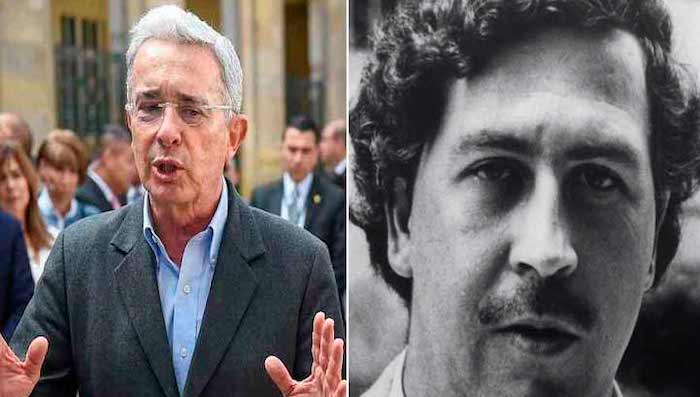
De acuerdo con los documentos desclasificados del Departamento de Estado, Uribe, quien gobernó en Colombia entre 2002 y 2010, recibió financiamiento ‘para sus campañas electorales al Senado por parte de la familia Ochoa Vásquez, miembro del cartel de Medellín’.
En esta información, amplificada este sábado por medios de prensa colombianos, se detalla que la relación de Uribe con el grupo del capo del narcotráfico Pablo Escobar data de 1993.
Presuntamente, Escobar exigió a Uribe -a través de ‘Los Ochoa’- que le ayudara a comunicarse con el entonces presidente César Gaviria (1990-1994) ‘a cambio del favor’ de la financiación de su campaña, recalca el medio DW.
De esta manera, Uribe queda mal parado en el ámbito político colombiano, pues las revelaciones del Departamento de Estado de Estados Unidos contradicen sus palabras, que siempre negaron rotundamente su relación con los carteles del narcotráfico.
Uribe, mentor del actual mandatario de Colombia, Iván Duque, todavía no dio su versión sobre este nuevo escándalo.
En febrero de 2002, aseguró que su relación con los Ochoa no tenía nada que ver con la droga: ‘Lo que nos unía no era el narcotráfico, sino los caballos. Era un mundo sano, de fincas, caballos, tiple, aguardiente y poesía. Luego, por circunstancias conocidas, cada familia tomó caminos diferentes’, enfatizó.
En el pasado, muchas publicaciones, políticos y agencias de inteligencia vincularon a Uribe con los carteles de la droga y el paramilitarismo, sin embargo siempre dijo que se trataban de ataques teledirigidos desde la oposición, para dañar su imagen. PL (26 de ciembre del 2020).
U.S. INTELLIGENCE LISTED COLOMBIAN PRESIDENT URIBE AMONG
“IMPORTANT COLOMBIAN NARCO-TRAFFICKERS” IN 1991
Then-Senator “Dedicated to Collaboration with the Medellín Cartel at High Government Levels”
Click here to read the document
|
Confidential DIA Report Had Uribe Alongside Pablo Escobar, Narco-Assassins Uribe “Worked for the Medellín Cartel” and was a “Close Personal Friend of Pablo Escobar” |

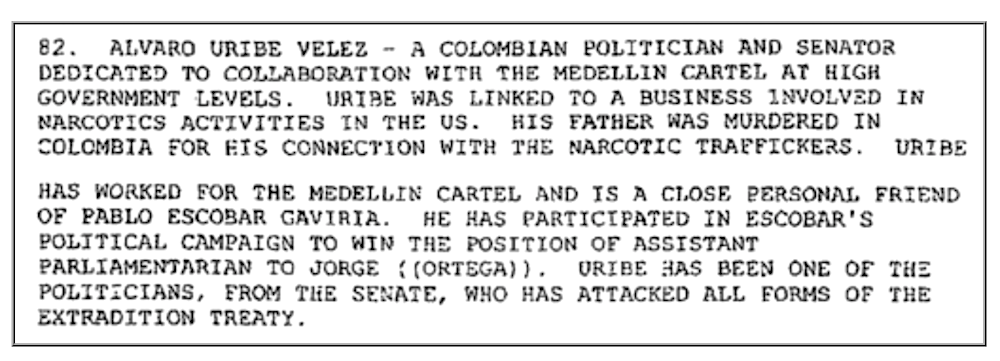
Washington, D.C., 1 August 2004 – Then-Senator and now President Álvaro Uribe Vélez of Colombia was a “close personal friend of Pablo Escobar” who was “dedicated to collaboration with the Medellín [drug] cartel at high government levels,” according to a 1991 intelligence report from U.S. Defense Intelligence Agency (DIA) officials in Colombia. The document was posted today on the website of the National Security Archive, a non-governmental research group based at George Washington University.
Uribe’s inclusion on the list raises new questions about allegations that surfaced during Colombia’s 2002 presidential campaign. Candidate Uribe bristled and abruptly terminated an interview in March 2002 when asked by Newsweek reporter Joseph Contreras about his alleged ties to Escobar and his associations with others involved in the drug trade. Uribe accused Contreras of trying to smear his reputation, saying that, “as a politician, I have been honorable and accountable.”
The newly-declassified report, dated 23 September 1991, is a numbered list of “the more important Colombian narco-traffickers contracted by the Colombian narcotic cartels for security, transportation, distribution, collection and enforcement of narcotics operations.” The document was released by DIA in May 2004 in response to a Freedom of Information Act request submitted by the Archive in August 2000.
The source of the report was removed by DIA censors, but the detailed, investigative nature of the report — the list corresponds with a numbered set of photographs that were apparently provided with the original — suggests it was probably obtained from Colombian or U.S. counternarcotics personnel. The document notes that some of the information in the report was verified “via interfaces with other agencies.”
President Uribe — now a key U.S. partner in the drug war — “was linked to a business involved in narcotics activities in the United States” and “has worked for the Medellín cartel,” the narcotics trafficking organization led by Escobar until he was killed by Colombian government forces in 1993. The report adds that Uribe participated in Escobar’s parliamentary campaign and that as senator he had “attacked all forms of the extradition treaty” with the U.S.
“Because both the source of the report and the reporting officer’s comments section were not declassified, we cannot be sure how the DIA judged the accuracy of this information,” said Michael Evans, director of the Archive’s Colombia Documentation Project, “but we do know that intelligence officials believed the document was serious and important enough to pass on to analysts in Washington.”
In a statement issued on July 30, the Colombian government took exception to several items reported in the document, saying that Uribe has never had any foreign business dealings, that his father was killed while fleeing a kidnap attempt by FARC guerrillas, and that he had not opposed the extradition treaty, but merely hoped to postpone a referendum to prevent the possibility that narcotraffickers would influence the vote.
The communiqué, however, did not deny the most significant allegation reported in the document: that Uribe had a close personal relationship with Pablo Escobar and business dealings with the Medellín Cartel.
The document is marked “CONFIDENTIAL NOFORN WNINTEL,” indicating that its disclosure could reasonably be expected to damage national security, that its content was based on intelligence sources and methods, and that it should not be shared with foreign nationals.
Uribe, the 82nd name on the list, appears on the same page as Escobar and Fidel Castaño, who went on to form the country’s major paramilitary army, a State Department-designated terrorist group now engaged in peace negotiations with the Uribe government. Written in March 1991 while Escobar was still a fugitive, the report was forwarded to Washington several months after his surrender to Colombian authorities in June 1991.
Most of those on the list are well-known drug traffickers or assassins associated with the Medellín cartel. Others listed include ex-president of Panama Manuel Noriega, Iran-contra arms dealer Adnan Khashoggi, and Carlos Vives, a Colombian entertainer said to be connected to the narcotics business through his uncle.
Click here to read the document
23 September 1991 (Date of Information 18 March 1991)
Narcotics – Colombian Narco-trafficker Profiles
Defense Intelligence Agency, Intelligence Information Report, Confidential, 14 pp.
Source: Declassification Release Under the Freedom of Information Act, May 2004
muchos colombianos ya lo sabian, muchos lo sospechaban, pero sus seguidores siempre lo han negado. Creo que es noticia vieja.